How Does an Infant Warmer Work? A Complete Guide to Infant Radiant Warmers
A newborn baby loses body heat up to four times faster than an adult. A full-term infant can drop 1 to 2°C within the first minutes after birth. A preterm or low-birth-weight baby can drop even faster.
This matters more than most people realise. Hypothermia in newborns is linked to breathing difficulty, low blood sugar, bleeding inside the skull, and higher mortality. The World Health Organization lists keeping the baby warm, the "warm chain", among the essential elements of newborn care.
The single most important piece of equipment in that first hour is the infant warmer, also called an infant radiant warmer, baby warmer, or infant warmer machine. If you have walked past a hospital labour room or NICU and seen a baby lying on an open cot under what looks like an inverted umbrella, that is it.
Why do hospitals treat this device as essential equipment rather than a nice-to-have? The benefits of an infant warmer come down to three things:
- Newborns cannot regulate their own temperature well. Preterm babies especially lack the fat stores and reflexes adults rely on.
- Cold stress compounds everything else. A hypothermic baby burns oxygen and glucose to generate heat, which worsens breathing problems and low blood sugar. Warmth is often the precondition for treating everything else.
- Warmth without confinement. Unlike swaddling or wrapping, a radiant warmer keeps the baby fully accessible for assessment, procedures, and skin-to-skin contact.
In this guide we explain how an infant warmer actually works, what each control mode does, how it differs from an incubator, and what to look for when selecting one. We also describe how our own radiant warmer, the Phoenix NWS 101, puts these principles into practice.
What is an infant radiant warmer?
An infant radiant warmer is an open care system that keeps a newborn warm using radiant heat. Infrared energy travels from a heating element mounted above the cot down to the baby's mattress.
Unlike an incubator, the baby is not enclosed. The infant lies on an open mattress with full access for medical staff, while the overhead heater keeps the cot warm.
The open design is the point. The babies who need warmth most urgently, babies being resuscitated, observed after delivery, or undergoing procedures, are exactly the babies clinicians need to reach instantly. A radiant warmer keeps the baby warm and keeps the baby accessible at the same time.
The four components that do the work
Every infant radiant warmer, from the simplest to the most advanced, is built around four systems.
1. The radiant heat source
The heater is typically a quartz heating element mounted in the head of the unit. A parabolic reflector sits behind it. The reflector's job is optical, not decorative: it shapes the infrared energy so warmth spreads evenly across the cot mattress instead of pooling in one hot spot under the heater.
Even distribution matters clinically. A mattress with cold corners forces staff into a bad choice: overheat the baby's torso, or leave the extremities cool.
On the NWS 101, the quartz heater delivers warmth uniformly across the bed, and the heater head can be swivelled and adjusted for height so the same unit works across different cots and bed heights.
2. The temperature sensing system
A warmer that cannot measure cannot protect. A flexible thermistor probe is attached to the baby's skin, usually on the abdomen. The probe reads the baby's actual skin temperature continuously and reports it to the controller.
This is what separates a warmer from a simple heater. The device does not decide how much heat to give based on a dial setting. It decides based on what the baby's body is actually doing.
3. Servo control, the brain of the warmer
Servo control is the feedback loop that makes a modern infant warmer safe. It works like this:
- The clinician sets a target skin temperature, commonly around 36.5 to 37°C.
- The skin probe measures the baby's actual temperature many times per second.
- The microprocessor compares the two and adjusts heater power continuously. If the baby's temperature drops slightly, heat output rises. If the baby warms toward the target, heat output eases off.
The heater output therefore always matches the baby's current need, not a decision made an hour ago. This matters because a newborn's thermal needs change quickly, after a bath, during a procedure, or as the baby's own thermoregulation matures over the first days.
Two other modes matter in practice:
- Servo air mode controls the temperature of the air around the baby instead of the skin. It is used when a skin probe is impractical, for example with extremely preterm babies whose skin is too fragile, or during procedures where the probe must come off.
- Pre-warm mode brings the cot up to temperature before the baby is placed in it, so the baby never starts care on a cold mattress.
Manual mode still exists and has its uses, for brief procedures or when the probe is disconnected. But servo skin mode is the default for ongoing care because it protects against both underheating and overheating automatically.
4. The alarm system
A good warmer is loud about problems. The alarms that matter:
- Probe failure or detachment. A skin probe that falls off would read as "baby is cold" and drive the heater toward maximum. Quality warmers detect the detachment and reduce heat instead. Our NWS 101 lowers temperature gradually when it detects a detached probe, protecting the baby from hyperthermia.
- Over-temperature. An independent safety limit shuts the heater down if the cot exceeds a safe ceiling, even if the control loop has failed.
- Power failure. The NWS 101's display carries battery backup, so temperature readings stay visible during outages. In facilities with unreliable power, this small feature matters enormously.
Infant warmer vs incubator: which one, and when?
This is the comparison clinicians and hospital buyers ask about most. The answer comes down to access versus enclosure.
| Radiant warmer | Incubator (isolette) | |
|---|---|---|
| Design | Open cot, heater above | Closed, enclosed cabin |
| Heat loss addressed | Mainly radiation and convection | Convection, with controlled humidity |
| Best for | Delivery rooms, resuscitation, short-term intensive observation, procedures | Longer-term care of preterm and low-birth-weight babies |
| Access | Immediate, unobstructed | Through portholes |
The two are complements, not competitors. A typical journey: an unstable newborn starts under a radiant warmer in the labour room or resuscitation bay. Once stabilised, the baby moves to an incubator for the days or weeks of growth that follow. Many NICUs keep both, and some units combine the two functions in a single hybrid device for transition care.
When is a radiant warmer used?
- In the delivery room, during the golden hour. Drying, stimulation, initial assessment, and skin-to-skin contact all happen under radiant warmth.
- Resuscitation. Open access is essential, and the WHO recommends keeping the resuscitation area at 24 to 26°C at minimum.
- Thermal recovery. Bringing a hypothermic baby back to normal temperature gradually and safely.
- Procedures and observation. Cannulation, exchange transfusion, and post-operative monitoring, anything where the team needs constant hands-on access.
- Kangaroo mother care transitions. Warming the environment while the baby is out for skin-to-skin time with the mother.
Types of infant warmers
"Infant warmer" covers a family of devices built for different settings and budgets. Knowing the types makes buying conversations much easier.
Fixed radiant warmers. The standard NICU and labour room unit: an open cot with an overhead heater, like the NWS 101. These are the workhorses, with servo control, alarms, and space for procedures.
Bedless warmers. The same heating and control system on a low T-shaped base instead of a full bed with cabinet. The base slides under a mother's bed or other equipment, which makes these the right choice for tight rooms and postnatal wards.
Portable and transport warmers. Lightweight warming for moving a baby between rooms, or for facilities without reliable electricity. The most striking example is the Embrace infant warmer, a sleeping-bag style warmer developed with input from Stanford engineers that stays warm for hours without constant power. It was designed for low-resource settings and has cared for thousands of babies. We wrote about what makes the Embrace infant warmer different if you want the details.
Hybrid warmer incubators. Combination units that switch between an open warmer mode and a closed incubator mode. They cost more, but they let a baby transition from intensive observation to longer-term growth without a risky handover between devices.
Warming mattresses and pads. Used under premature babies or during transport and surgery. These are complements to a warmer rather than replacements.
What to look for when selecting an infant warmer
Buyers comparing infant warmers should look past the brochure photos. These are the fundamentals:
- Modes of operation. At minimum servo skin and manual. Servo air and pre-warm modes add real clinical flexibility.
- Even heat distribution. Ask about the heater and reflector design. Uniform warmth across the mattress beats peak output numbers.
- Probe safety behaviour. What exactly happens when the skin probe detaches? The wrong answer is "nothing".
- Memory and display backup. Can staff still read temperatures during a power cut, and does the warmer restore its settings when power returns?
- Bed positioning. A mattress that tilts, supporting Trendelenburg and Fowler's positions, helps with specific clinical situations.
- Imaging access. Some warmers pivot the heater module out of the way so a baby can be X-rayed without being moved.
- Cleaning and infection control. Look for removable, washable side panels and surfaces that tolerate proper disinfection between patients.
- Safety standards. IEC 60601-2-21 is the dedicated safety standard for infant radiant warmers. IEC 60601-1 covers general electrical safety, and ISO 13485 covers the manufacturer's quality system. CE marking indicates conformity for the European market. Ask for certificates, not marketing claims.
- Workflow fit. Height adjustment, swivel heater head, drawer storage for supplies, and where space is tight, a bedless model with a T-shaped base that slides under a mother's bed. The NWS 101 covers all of these, because different hospital rooms have different constraints.
- Serviceability. A control panel that can be removed easily for service keeps the unit in use rather than in the workshop.
See it in practice: the Phoenix NWS 101
All of these principles come together in our own infant radiant warmer, the NWS 101, in use in labour rooms and neonatal ICUs:
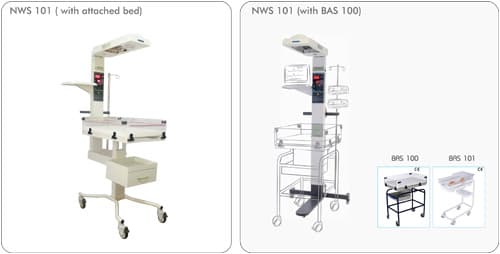
The NWS 101 is designed for real ward conditions. It gives you servo and manual heat control, uniform warmth from the quartz heater across the bed, and a battery-backed display so temperature readings survive power cuts. The heater head swivels and adjusts for height, drawers keep supplies within reach, and a bedless T-shaped base variant slides under a mother's bed where space is tight.
See the full specifications on the Infant Radiant Warmer NWS 101 product page.
Bringing it together
An infant radiant warmer looks simple: a heater, a reflector, a probe, and a control loop. But each element carries clinical weight. The heater must spread warmth evenly. The sensor must read the baby accurately. The servo loop must respond continuously. The alarms must catch the failure modes that tired humans miss.
When all four work together, the device quietly does one of the most important jobs in the hospital: keeping a newborn's temperature inside the narrow band where a baby can stabilise, grow, and go home.
At Phoenix Medical Systems, we have spent years refining the radiant warmer around exactly these principles, from our NWS 101 for labour rooms and NICUs to the Embrace infant warmer designed for low-resource settings.
If you are selecting a warmer for your facility, read our guide to choosing a warmer for newborns or contact us and our team will help you match the right warmer to your clinical setting. Buyers in India can also find the full Phoenix range on our IndiaMART store.